The Greasy Wheel: Why the Working Class is Eating Itself to Death One Gas Station Hot Dog at a Time
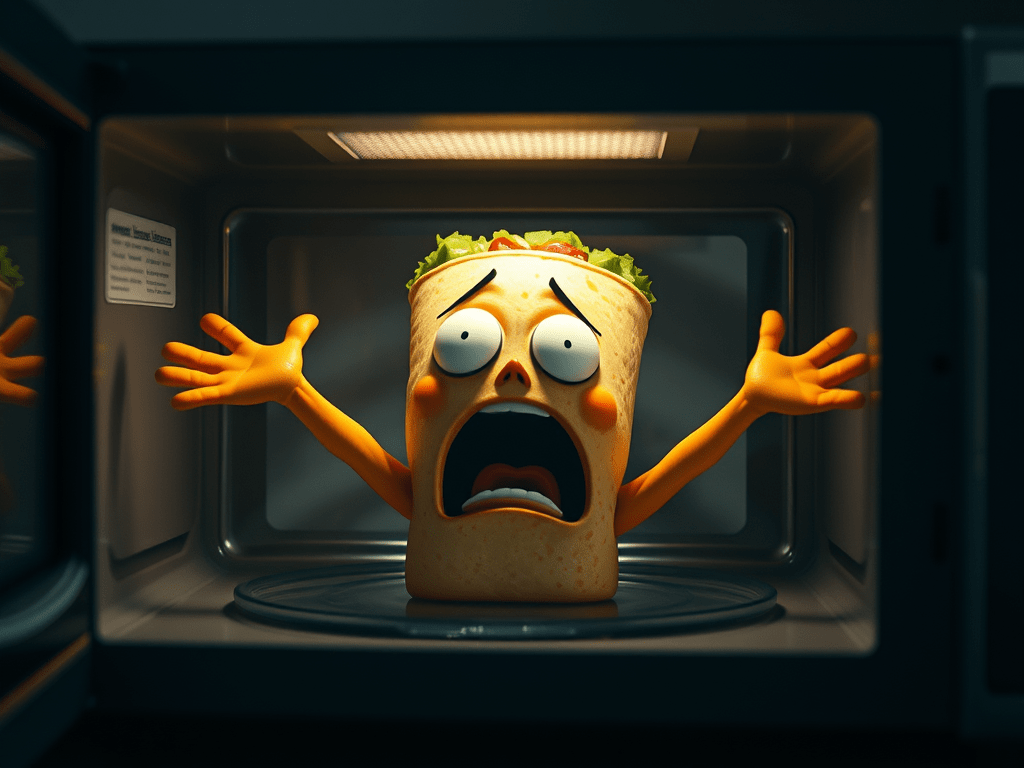
You ever watch someone microwave a burrito from a gas station, and for a second, feel like you’re witnessing a war crime? The foil-wrapped torpedo rotates slowly on that nuclear carousel like it’s about to be launched into someone’s lower intestine with all the subtlety of a hand grenade. And yet, for millions of Americans, that’s dinner. Or breakfast. Or sometimes both, if they’re lucky enough to have two jobs.
It’s not because they’re stupid. It’s not because they don’t care. It’s because our system is designed with the culinary finesse of a monster truck rally. It’s loud, fast, cheap, and guaranteed to explode your insides.
Convenience, Calories, and Capitalism
Let’s get this out of the way: Ultra-processed foods are killing us.
According to the NIH, people who consumed a diet dominated by ultra-processed foods ended up eating about 500 more calories per day than those who didn’t, leading to weight gain in just two weeks. Two weeks! That’s barely enough time to finish a Netflix series, let alone destroy your pancreas.
As George Carlin once said, “The caterpillar does all the work, but the butterfly gets all the publicity.” In America, the working class is the caterpillar. They grind, toil, haul, stack, stock, serve, and swipe, all while fluttering through drive-thrus hoping their bodies don’t go full chrysalis before payday.
And what do they eat for all this effort? Things with ingredient lists that read like chemical warfare reports. Polysorbate 80, sodium nitrate, high fructose corn syrup… if it sounds like it belongs in a Breaking Bad episode, it’s probably in your lunch.
The 30-Minute Lunch Break: Hunger Games, But Real
We tell working-class people to eat better, as if they’re refusing to pick kale on principle. “Just pack your lunch!” chirp the Instagram influencers from their avocado-toast-filled kitchens in Los Feliz. Yes, Brenda, I’m sure your oat milk latte tastes better when you’re not being screamed at by your boss in a windowless warehouse.
The reality? You’ve got 30 minutes to eat. And that 30 minutes includes walking to your car, finding food, waiting in line, and returning to work—preferably without sweating like a convict on parole. That doesn’t leave much time for steamed vegetables.
The system isn’t just unsympathetic to nutrition—it’s actively hostile. It is structurally easier to find a Taco Bell in most cities than it is to find a grocery store. Why? Because hot sauce packets are cheaper than public health.
From Salt to Sisyphus: Addictive Food and the Myth of Willpower
Let’s talk about the chemical romance between your brain and that $1 sausage biscuit.
Ultra-processed foods are scientifically engineered to hijack your brain’s reward system. That perfect mix of fat, sugar, and salt doesn’t just taste good—it triggers dopamine releases on par with some recreational drugs. No, really. If Velveeta had a Tinder profile, half the working class would swipe right.
To blame someone for craving a Crunchwrap Supreme is like blaming a fish for biting a hook. This isn’t a failure of discipline—it’s neurochemical warfare.
Michael Moss, author of Salt Sugar Fat, explains: “The food industry doesn’t sell food. It sells addiction.” And like any good cartel, they make sure the product is available on every corner, especially in neighborhoods where people are too busy surviving to be picky.
The Preposterous Paradox of “Choice”
We tell people they should “make better choices,” as if the entire food supply isn’t booby-trapped.
That’s like telling someone in the Sahara to hydrate better. “Just drink more water!” What water, Karen? You mean that murky plastic jug of store-brand cola that costs less than a bottle of spring water? Or the $3 celery sticks wrapped in plastic like they’re heirlooms?
In food deserts—areas with limited access to fresh food—your choices are limited to either gas station jerky or freezer-burned pizza. And let’s be honest, when you’ve worked a double shift and your legs feel like Jell-O, you’re not about to make a beet salad. You’re about to crush six mozzarella sticks and contemplate your life while watching reruns of Pawn Stars.
Meal Prepping: The Hobby of the Privileged
Oh, meal prepping. The sacred grail of internet wellness culture. Where people arrange grilled chicken and quinoa into little plastic containers like they’re Marie Kondo-ing their intestines.
Sounds noble. Sounds efficient. Sounds completely inaccessible for someone who gets home at 10 p.m., has three kids, and works Saturdays.
Preparing healthy food requires time, storage, cookware, planning, and a kitchen that doesn’t double as a laundry room. That’s a lot to ask when you live in a motel room with a microwave that turns everything into lava on the outside and ice on the inside.
Food as Vice, Food as Escape
Here’s the rub: food isn’t just fuel. For the working class, it’s often the only reliable comfort.
Can’t afford therapy? Eat a doughnut.
Can’t afford a vacation? Get takeout.
Can’t afford Netflix? Welcome to the Taco Bell dollar menu.
In a culture that commodifies everything, food becomes the working man’s drug. It’s legal, accessible, and socially acceptable. No one looks twice when you eat a burger to cope with stress—but light up a joint or cry in public and suddenly it’s “unprofessional.”
The late Anthony Bourdain, a man who knew a thing or two about hunger and struggle, once said, “Your body is not a temple, it’s an amusement park. Enjoy the ride.” The problem is, most amusement parks don’t come with insulin resistance and gout.
When Addiction is Branded as Convenience
Let’s talk marketing. If sin had a PR team, it would look like the fast-food industry.
Ads sell ultra-processed foods not as meals, but as relief. Relief from work, stress, poverty, loneliness. “You deserve a break today,” croons McDonald’s. Translation: “We’ve made life so intolerable that your only escape is deep-fried, salt-drenched comfort.”
The packaging is shiny. The mascots are smiling. The food is cheap. It’s all one carefully orchestrated lie. A lie designed to get you to trade your health for five minutes of pleasure in a paper bag.
Systemic Illnesses Require Systemic Solutions
If we want to fix this, we need to stop pretending it’s about personal failure. This is a policy failure. A social failure. A failure of imagination.
We need laws that regulate the marketing of ultra-processed foods the same way we regulate tobacco. We need workplace standards that allow for longer, humane lunch breaks. We need infrastructure that puts fresh food within reach, not just for those with a Trader Joe’s down the street, but for every family living next to a Dollar General.
We need to change the default setting from “survival mode” to “human being with dignity and fiber in their diet.”
Humor in the Hunger
Because sometimes, the only way to survive the absurdity is to laugh at it.
What’s the difference between a working-class lunch and a prison meal?
One comes with a receipt. (And sometimes fewer vegetables.)
Why don’t ultra-processed foods rot?
Because even bacteria know better.
If you think about it, modern America is just a giant vending machine where the healthy options are always sold out and the candy bars are half-melted.
Conclusion: We’re Not Broken. The System Is.
Let’s stop wagging our kale-covered fingers at those struggling to make ends meet. If you’ve never juggled two jobs and tried to feed your kids on $20, you don’t get to judge someone’s Cheetos habit.
Food is culture. Food is medicine. Food is joy. But food has also become weaponized against the working class.
It’s not enough to hand people a cookbook and wish them luck. We need to hand them a ladder out of systemic poverty, out of addiction-centered food marketing, and into a society where broccoli doesn’t cost more than rent.
Until then, the gas station hot dog will remain the unofficial mascot of late-stage capitalism: cheap, dangerous, and always spinning.

Leave a comment